
What Ergonomic Risks Matter Most?
Ergonomic Risks
There are 4 primary ergonomic risk factors:
- High Force/Effort
- Awkward Postures
- High Repetition
- Long Durations
But these are not of equal concern. And often there are combinations of these risks which create exponentially higher risk.
An important note about “Awkward Postures”. While high force typically applies to external force/effort that an employee must use to perform a task, awkward postures increase internal joint forces. Awkward postures require us to work harder (use more effort) which increases those internal joint forces.
Test yourself! Bend your wrist and pinch your fingers as hard as you can. Then put your wrist in a neutral/natural position and pinch your fingers as hard as you can. Notice the big difference in your pinch force capability? Notice how hard you had to work in the bent position but had a much lower force capability?
So what risks should you focus on to get the biggest impact?
Lowest Priority Ergonomic Risks
Spending time addressing these types of tasks or movements will provide little impact or benefit.
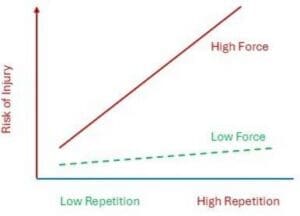
- Low force/effort + high repetition
- Near-neutral postures + high repetition
Highest Priority Ergonomic Risks
So what risks should you identify and correct to get the biggest positive impact and reduce pain and injuries?
Spending time addressing these types of tasks or movements will provide significant positive impact and benefit depending on the degree to which you can eliminate or reduce the risk intensity.
- High force/effort + high repetition
- Awkward postures + high repetition
Please note, what is “forceful” or “heavy” for the lower body is different than for the upper body. You know this intuitively. The legs are much more powerful than our hands.
For example, repetitive heavy lifting, pushing, pulling, or carrying will have very high risk to the low back and shoulders. And repetitive pinching will have very high risk to the hand, wrist, and forearm.
Why are these Risk Combinations so Dangerous?
These risk combinations significantly increase the risk of injury due to a principle called “fatigue failure”. The simplest example of materials fatigue failure is what happens to a paper clip when you bend it repeatedly back and forth at one spot. It snaps. It breaks. It fails.
Just like with materials fatigue failure, our body’s “materials” – tendons, muscles, ligaments, discs, nerves – fail when they are overly fatigued.
The higher the force/effort, the greater recovery time our body’s soft tissues need. High repetitions don’t allow sufficient recovery, so we hit that “fatigue failure” faster.
This risk combination causes or contributes to symptoms and injuries in the low back, wrists, forearms, shoulders, and knees.
Let us help you identify and prioritize your risks and corrective actions!
Email us Contact@ErgoFitConsulting.com or submit your information here: Reach Us