
The Aging Workforce: What to Do About it?
Is this aging workforce good, bad, or both?
Workers 55-years-old and older now make up nearly a quarter (25%) of the US workforce and is the fastest growing age group in our labor force according to the Bureau of Labor Statistics (BLS).
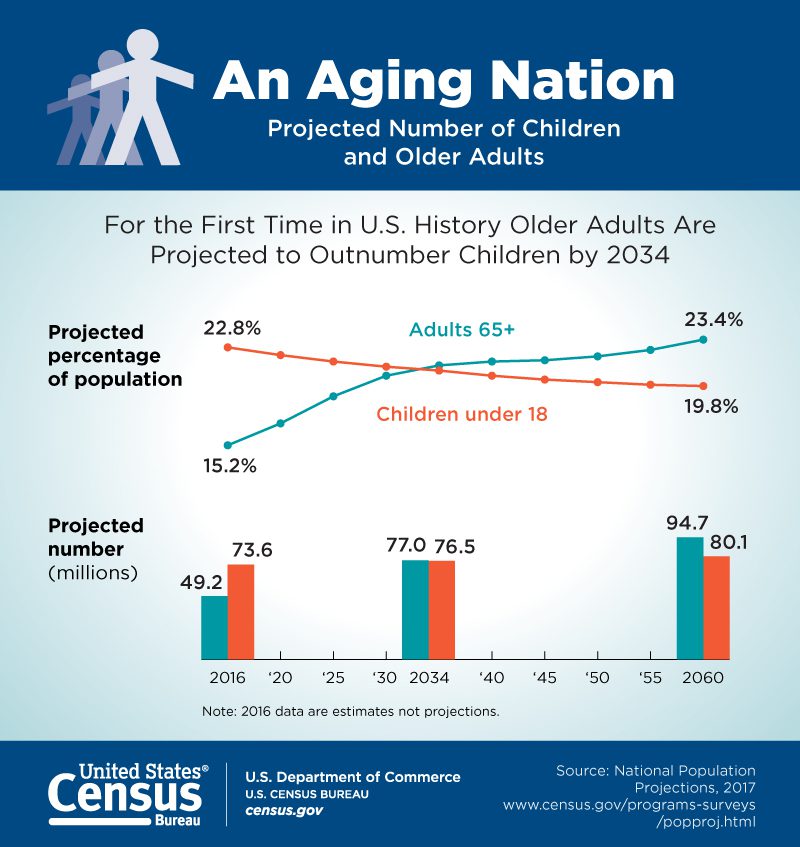
According to 2019 US Census data, by 2034 older people are projected to outnumber children for the first time in U.S. history.
The BLS projects that the 75-year-old and older labor sector is expected to grow by 96.5% between 2020 and 2030, but the overall labor force participation rate will slightly decline. And according to the Society for Human Resources Management (SHRM), more of this older cohort is working full-time than part-time.
The median age of the U.S. population is expected to reach age 43 by 2060. Add to that:
- A growing number of high school dropouts
- Fewer high school graduates with vocational training
- Labor “imports” decreasing due to security restrictions here and better opportunities in rapidly developing countries
…and we NEED older workers to be working!
What should employers do about this aging workforce?
In this article we include these three topics:
1. Leverage Deep Knowledge, Skills, & Attributes
2. Protect & Optimize! Ergonomics for Older Workers = Ergonomics for All
3. Stop Age Discrimination
Leverage Deep Knowledge, Skills, & Attributes
Older workers bring a combination of tremendous strengths and indispensable attributes to the job. This is why 40% of HR professionals surveyed report that they outperform younger workers (https://www.shrm.org/foundation/older-workers).
Here is a sampling of older worker super-powers that many younger workers lack, and which can optimize your organization:
- Exceptional soft skills
- Leadership skills and experience
- Professionalism
- Strong work ethic
- Commitment to quality
- Grit and resilience
- Deep technical and subject-matter expertise
- Integrated and systems thinking skill
- Creative problem-solving skills from life experience
- Practical wisdom
- High job engagement and loyalty
- Low absenteeism
- Adaptability
- Dependable in a crisis
- Institutional knowledge

A universal design approach to your training will be effective and inclusive for all employees, such as on-the-job training, step-by-step guides, audio & visual accessibility training.
And 2-way mentoring programs go a long way toward upskilling or reskilling all employee age groups, as older workers and younger workers have different valuable skills to teach one another. This, in turn, will strengthen collaboration and culture for better all-employee engagement and optimization.
Protect & Optimize! Ergonomics for Older Workers = Ergonomics for All
Older workers will leave if work is too demanding or poorly matched to capabilities. Corporate productivity is greatly dependent on the health and safety of older employees.
The DOL advises employers to implement a variety of workplace practices, such as wellness programs, changes in job design, and specifically ergonomics to reduce the demands of a job in order to retain talented, aging workers.
Ergonomic improvements that include aging effects will reduce the physical and cognitive demands for all age ranges and abilities, rendering them safe and lower stress for most or all employees!
In our “Creating the Age-Friendly Workplace” management training, we recommend these 3 steps:
1. Educate management on common physiological aging effects
2. Identify and prioritize improvements
- Organization-level: which policies directly or indirectly bias against older workers?
- Job-level: where is there a mis-match between job demands (physical, cognitive, sensory) vs older workers capabilities?
- Task-level: which tasks should be modified for all ages to perform the physical, cognitive, and sensory demands?
3. Select and implement improvements at the organization level, job design level, and task demands level; using policy, design, engineering, and administrative improvements.
Stop Age Discrimination
According to a 2025 AARP research survey, 64% of 50-year-old and older employees report seeing or experiencing age discrimination in the workplace, and 22% report feeling pushed out of their roles because of their age.
Be compliant with the Federal Age Discrimination in Employment Act (ADEA) which protects workers and applicants age 40-years-old and and older and applies to employers with more than 20 employees. It prohibits age-based discrimination for any term or condition of employment, such as hiring, wages, benefits, promotions, layoffs, and firing. (https://www.eeoc.gov/statutes/age-discrimination-employment-act-1967)
And states may have additional protections to comply with.
Hiring and firing practices seem to be a focus of age discrimination lawsuits. To protect your organization, consider the following:

1. Base hiring, promotion, and firing decisions on objective skills.
- Remove all language implicating a bias toward younger candidates, such as “digital native” or “recent college grad”.
- The stereotype that older workers have trouble learning is completely false. According to a (SHRM) research report, most like to learn and grow. And those who apply for tech jobs actually embrace continuous learning around tech.
2. After your ergonomic solutions have been implemented to allow all workers to be able to perform the essential functions of the job, post your age-friendly and ergo-friendly job descriptions to highlight how you protect all employees, helping you attract and retain top talent.
Summary
Once your solutions are in place, you can confidently promote both employee health and long-term employability! Posting your age-friendly & ergo-friendly job descriptions to highlight how you protect all employees will let you win the recruitment game by attracting and retaining top talent!
Implementing ergonomic and other older worker solutions will help protect your organization against age discrimination lawsuits, will protect the entire workforce from injuries, upskill all age cohorts across your organization, AND will optimize productivity at the same time!
A true business strategy that many organizations overlook. Will you?
Interested in our “Creating the Age-Friendly Workplace” management training? Inquire here.
