
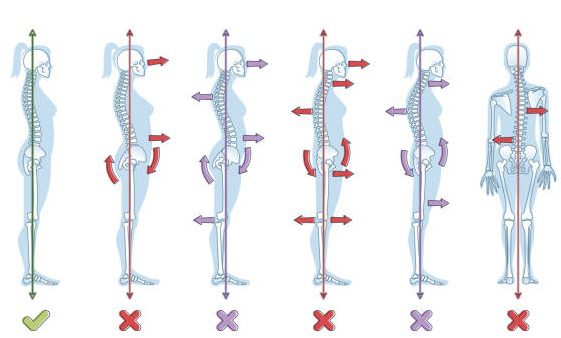
Neutral Posture: Reconnect with Your Body’s Natural Balance
In a world that keeps you moving, it’s easy to forget: your body flourishes when it is in alignment. Whether you’re sitting at a desk, or chasing weekend hobbies, your posture plays a powerful role in how you feel. And at the heart of it all is neutral posture or proper alignment. Positioning that helps your body work with itself, not against itself.
Let’s unpack what that is, why it’s important, and how you can begin finding your own “neutral” today.
What Is Neutral Posture?
The University of San Francisco, Office of Environment, Health and Safety defines neutral posture as:
- A posture that reduces stress on muscles and joints
- A position of ease that the body can maintain over time
- A position that supports the natural curves of your spine
- A posture you can sustain comfortably with minimal effort
- A position that gives your body mechanical advantage for everyday tasks
In simple terms, neutral isn’t about perfection, it’s about efficiency and comfort.
It’s the difference between holding yourself upright with strain… and allowing your body to naturally support itself.
A Simple Check-In: How Aligned Are You?
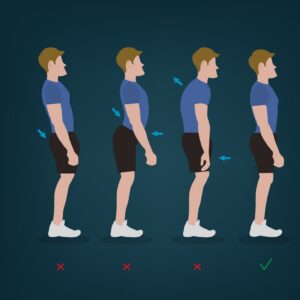
Before you change anything, start with awareness.
Stand naturally and imagine drawing a straight line from the top of your head down to your feet. Now ask yourself:
- Are your feet pointing forward, evenly grounded?
- Do your shoes wear unevenly (inside or outside)?
- Are your ankles, knees, and hips stacked in a straight line?
- Does your spine maintain its natural curves, not overly arched or slouched?
- Are your shoulders straight above your hips?
- Are your ears straight above your shoulders?
This alignment is often called a “plumb line”, a visual guide for balance.
If something feels off, that’s not a problem, it’s an invitation to investigate.
Curious Exploration: Feel the Difference
The best way to understand posture isn’t through instruction, it’s through sensation.
Let’s try this:
- Let your head drift forward
- Pay attention to the tension in your neck and upper back
- Now gently bring your ears back over your shoulders
- Feel the difference in ease and support
OR
- Lengthen your spine and open your chest
- Notice how your breathing changes
- Feel how your back responds
These small experiments help you tune into your body’s signals. Over time, you’ll begin to recognize when something is “off”, and more importantly, how to correct it.
How does poor posture develop?
Repetitive reaching, sitting, and bending have a negative cumulative effect on the soft tissues in our bodies; like muscles, tendons, nerves, the discs in our spines, and sometimes even the ligaments that hold our bones together.
Most people develop poor posture over time by using poor working postures and not strengthening the opposite muscle groups.
This creates strength imbalances on either side of our joints… including the spine.
Then this imbalance causes wear and tear to the surrounding soft tissues.
Even worse, this leaves you performing sub-par no matter what the task is.
Take It on the Move
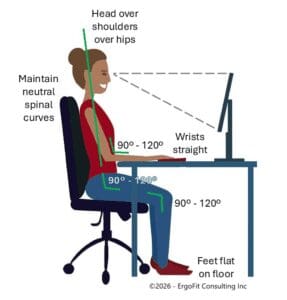
Posture isn’t just about standing still, it’s about how you move through the world.
As you walk, sit, bend, or reach, ask yourself:
- Can you maintain alignment, or do joints shift out of place?
- When you sit, does your spine stay long, or does it collapse?
- Are your shoulders still straight above your hips?
- Do your movements feel smooth, not strained?
- If you adjust toward neutral, does discomfort ease?
These moments of awareness are powerful. They turn posture from an abstract idea into a practical, everyday tool.
Listen to Your Body: Discomfort Is Information
Pain isn’t random, it’s often a message. If there’s discomfort, pause and check it out:
- Is the pain specific to a certain activity?
- Is there a movement pattern or habit contributing to it?
- Are you holding tension or working in awkward positions?
The further forward your head and shoulders are, the worse your range of motion will be, the more wear and tear you’ll have, and the more pain you may develop.
Eventually, this can make putting shirts on & off difficult, or even washing your hair difficult.
And as you age, it puts you at greater risk of falling.
Instead of ignoring discomfort, get curious about it. Your body is constantly giving feedback, it just needs your attention.
Practical Tips to Find, and Keep, Neutral
Building better posture doesn’t require perfection. It starts with small, consistent habits:
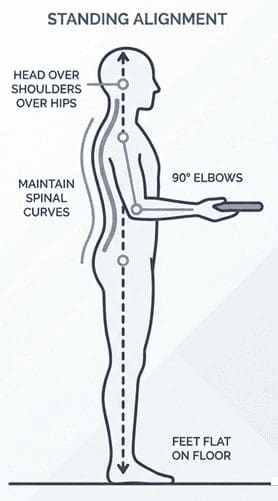
1. Align from the Ground Up:
Stack your Joints
- Feet grounded evenly
- Ankles over feet
- Knees over ankles
- Hips over knees
- Shoulders over hips
- Ears over shoulders
Think of your body as a well-balanced tower.
2. Avoid Staying Still Too Long
Even perfect posture becomes stressful if held too long.
- Shift positions
- Stand up frequently
- Move dynamically
Movement is just as important as alignment.
3. Create Gentle Reminders
Build awareness throughout your day:
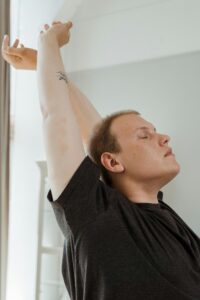
- Stretch between tasks; in the opposite position of your task positions
- Sit up and reset your posture
- Take a deep breath
Over time, these small actions become second nature.
4. Strengthen What Supports You
Posture isn’t just about positioning, it’s about strength.
- Build your core; hips, entire back, abs
- Strengthen stabilizing muscles
- Address imbalances
A strong foundation makes neutral posture effortless.
5. Move in Variety

Your body is designed for diversity of movement.
- Walk, stretch, bend, rotate
- Try new activities
- Avoid repetitive strain
Balanced movement keeps muscles, and posture, balanced.
Finding Neutral Posture: Your Body, Your Foundation
Your body is a remarkable system, a “mechanical miracle,” as some call it. But like any system, it functions best when aligned and supported.
Finding neutral posture isn’t about rigid rules or constant correction. It’s about awareness, curiosity, and small daily adjustments that add up over time.
When you move better, you feel better.
When you feel better, you live better.
So pause, check in, and ask yourself:
Where can I find neutral right now?
Contact us if you would like more information on our Stretch Breaks Program.
