
Ergonomics and Wellness: Creating Healthier Workplaces
When organizations talk about employee health, the conversation typically falls into one of two buckets: ergonomics or wellness.
The bucket in one hand, there are discussions about chairs, desks, monitor heights, and workstation assessments. The bucket in the other hand, there are conversations about stress, mental health, fitness challenges, and work-life balance.
The problem is that these topics are often managed separately, even though employees experience them as part of the same reality.
If someone is suffering from neck pain from a poorly setup workstation, that pain isn’t just in the ergonomics bucket. It impacts their concentration, their energy, their mood and even what they do outside of work. Likewise, an employee who is overwhelmed, burned out and chronically stressed isn’t going to be in a position to maintain healthy postures, take movement breaks or pay much attention to ergonomic best practices.
That’s why the distinction between ergonomics and wellness matters, but, according to the CDC’s Total Worker Health Program, so does recognizing where they overlap.

Ergonomics Is About the Environment
At its core, ergonomics focuses on how work is designed.
The goal is to create environments, tools, and processes that work with the human body rather than against it.
An ergonomic program might examine whether a desk is at the right height , a monitor is properly positioned , or repetitive tasks are creating unnecessary strain . Success is often measured by reduced discomfort, fewer injuries, and increased productivity.
In other words, ergonomics asks, “What can we change about the work environment?”

Wellness Is About the Person
Wellness takes a broader view.
It takes into account the factors that influence a person’s overall health and wellbeing, physical, mental, emotional and sometimes social. Wellness programs are often built to help employees develop better habits, reduce stress, stay active and find the support they need.
The question becomes, “What can we do to help people thrive?”
Wellness, unlike ergonomics, is not limited to what happens at a workstation. It recognizes that people bring their entire selves to work, with all the challenges and opportunities that brings.
Why the Difference Matters
Many organizations invest a lot in one area but neglect the other.
A company can promote wellness with step challenges, meditation apps and nutrition seminars, but most of an employee’s day is spent working in configurations that cause discomfort and fatigue.
On the other hand, a company could provide excellent ergonomic tools but overlook increasing stress, burnout or mental health problems.
And according to the CDC neither approach addresses the complete picture.
A height-adjustable desk won’t solve exhaustion. A mindfulness workshop won’t eliminate shoulder pain caused by a poorly positioned monitor.
Both have value. Neither is enough on its own.
Where They Come Together
The truth is that physical health and overall well-being are inextricably linked.
Discomfort can increase stress. Stress can increase discomfort. Fatigue can affect standing and mobility. Pain can impact sleep quality, motivation and mental health.
Employees don’t separate these experiences. They just feel the sum of the parts.
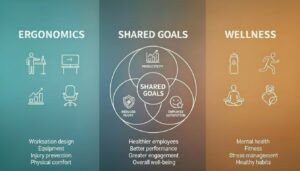
That’s why some of the most effective workplace health strategies bring ergonomics and wellness together.
Examples include encouraging regular movement in the course of the workday to support mental and musculoskeletal health; training employees in how to set up their workstations properly to reduce physical strain and increase comfort and productivity; and managing workload and recovery to improve wellness and reduce the physical tension that is often associated with stress.
The best programs recognize that people are not machines, and health is not one-dimensional.
A More Holistic Approach
As hybrid and remote work has developed, so has the need for a link between ergonomics and wellness. Many employees are navigating work environments that weren’t originally designed to be offices, while also trying to maintain healthy boundaries between work and personal life. Providing a good chair without fixing burnout, or vice versa, feels incomplete in this context.
The organizations where the greatest impact occurs tend to see employee well-being as a system, not a series of discrete programs. They look across individual programs to how physical comfort, mental health, movement, recovery and workplace culture are affecting each other.
Bringing Ergonomics and Wellness Together
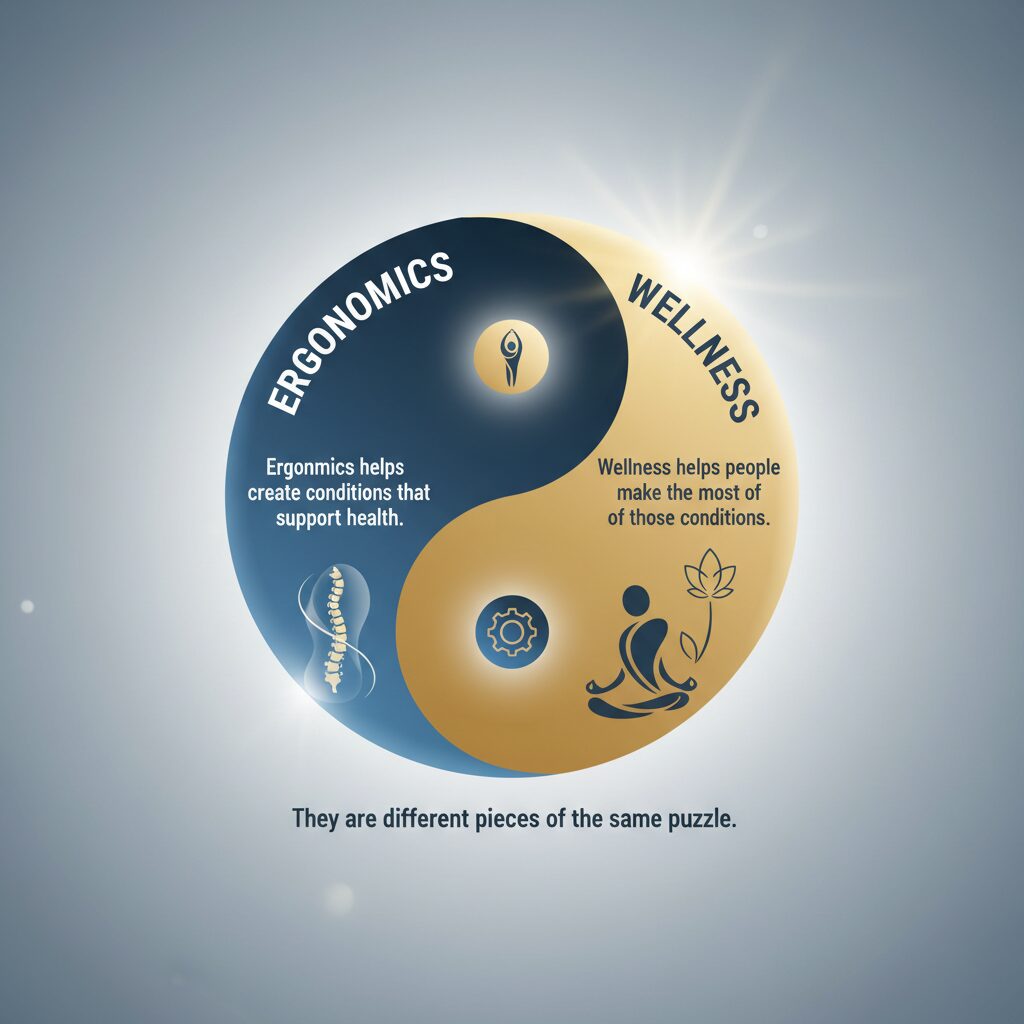
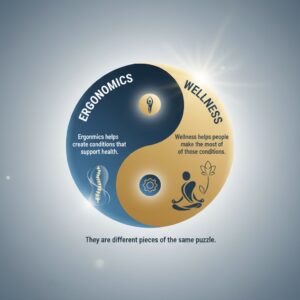
Ergonomics and wellness are not competing priorities. They are different pieces of the same puzzle. Ergonomics helps create conditions that support health. Wellness helps people make the most of those conditions.
When organizations stop treating them as separate conversations, they get closer to creating workplaces where employees are not only safer and more comfortable, but healthier, more engaged, and better equipped to do their best work. That is ultimately the goal, not better ergonomics or better wellness, but better outcomes for people.
Contact us if you would like information on any of our Wellness Workshops & Webinars.
